

If you are searching for a used Volkswagen Beetle engine, the most important step is matching the replacement to your Beetle’s year, engine size, engine code, cooling system, fuel setup, and transmission configuration. Classic Beetles were produced with several air-cooled flat-four engines, including 1200, 1300, 1500, and 1600 cc versions. These engines may look similar, but important differences developed over the Beetle’s production history.
A used VW Beetle engine can be a practical replacement when the original motor is worn, damaged, or missing. However, buying the first engine advertised as a “Beetle engine” can create compatibility problems. The safest approach is to identify the original engine, compare the replacement’s specifications, verify what components are included, and understand the engine’s condition before installation.
Understanding the Volkswagen Beetle Engine
The classic Volkswagen Beetle, also known as the Type 1, used a rear-mounted, air-cooled, horizontally opposed four-cylinder engine. Over its long production history, Volkswagen progressively increased engine displacement and updated the design.
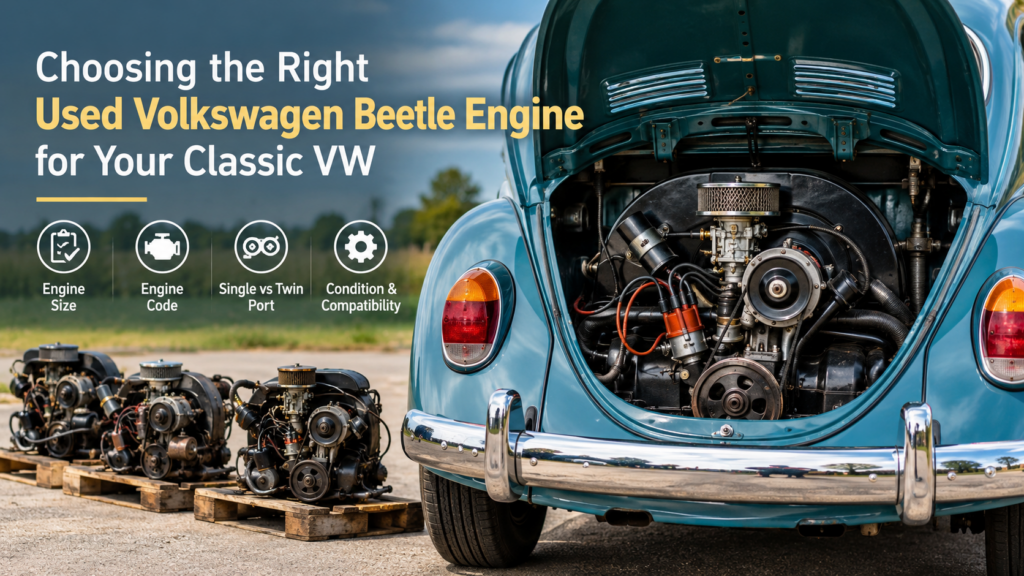
Common Beetle engine sizes included:
| Engine | Displacement | Typical historical application |
| 1200 | 1,192 cc | Earlier and later basic Beetle models |
| 1300 | 1,285 cc | Various mid-production Beetles |
| 1500 | 1,493 cc | Later 1960s Beetles and related models |
| 1600 | 1,584 cc | Later Beetles and Mexican production |
Volkswagen’s technical documentation lists the 1200, 1300, 1500 and 1600 engines with different bore and compression specifications.
The 1600 engine also evolved during its production life. Volkswagen introduced the 1.6-liter boxer engine in 1970, and later versions received additional technical updates, including electronic ignition and eventually fuel injection on certain Mexican Beetle applications.
Why Engine Size Alone Isn’t Enough
A search for a “1600 Volkswagen engine” can return several different configurations. The same basic displacement may have different:
- Cylinder heads
- Carburetors
- Intake systems
- Cooling components
- Ignition systems
- Engine codes
- Emissions equipment
- Electrical connections
- Exhaust arrangements
Therefore, used Volkswagen Beetle engine compatibility should be established using the vehicle’s complete configuration rather than displacement alone.
Which Engine Does Your Beetle Need?
Before searching for a replacement, identify the original engine as accurately as possible.
Check the Model Year
The Beetle changed considerably over the decades. Engine size, electrical systems, suspension, body configuration and other components evolved over time.
For example, Volkswagen documentation identifies 1200, 1300 and 1500 engines in the 1960s, while the 1600 became an important later Beetle engine.
The model year therefore provides an important starting point.
Find the Engine Identification
Look for the engine identification marking on the engine case. If the original engine is still installed, photograph the identification area before removing it.
Also record:
- Vehicle year
- Beetle model
- Engine size
- Engine code
- Transmission type
- Fuel system
- Electrical voltage
- Existing carburetor or injection setup
This information can help you distinguish between similar-looking engines.
Common Volkswagen Beetle Engine Sizes
1200 Engine
The 1,192 cc engine was one of the longest-running engine configurations associated with the Beetle. Depending on production period, output and specifications changed over time.
A 1200 replacement can therefore require more than simply confirming that the engine is a 1.2-liter VW motor.
1300 Engine
The 1,285 cc engine appeared during the mid-1960s and later evolved into additional configurations. Volkswagen technical data lists different compression and output specifications for 1300 versions.
When buying a used 1300 engine, compare the specific version with the original engine.
1500 Engine
The 1,493 cc engine represented another step in the Beetle’s engine development. Volkswagen introduced the 1500 Beetle in the 1960s, with the engine producing approximately 44 hp in the documented specification.
A replacement 1500 should be checked for the correct cylinder heads, carburetor arrangement, cooling equipment and other application-specific parts.
1600 Engine
The 1,584 cc engine became an important later Beetle powerplant. Volkswagen records the introduction of the 1.6-liter engine in 1970 and describes subsequent updates to the engine over time.
Later 1600 engines can differ substantially from earlier configurations, particularly in fuel and ignition systems. That makes model year and engine identification particularly useful when searching for a used VW Beetle engine.
What to Check Before Buying a Used Beetle Engine
A used engine purchase should begin with verification rather than price.
1. Confirm the Engine Code
Engine codes help identify the original configuration and production period.
If the listing doesn’t provide an engine code, ask the seller for identification details before purchasing.
2. Confirm the Displacement
Verify whether you need:
- 1200 cc
- 1300 cc
- 1500 cc
- 1600 cc
Do not assume that all classic VW engines can be substituted without additional changes.
3. Check the Cooling Configuration
The Beetle’s air-cooled engine relies on its cooling system for temperature management. Cooling shrouds, fan arrangements and related components should match the intended installation.
Some Volkswagen engines from other models used different cooling layouts. Type 3 engines, for example, used a different fan arrangement to create a lower engine profile.
That is an important reason not to buy a replacement simply because it is described as a “VW air-cooled engine.”
What Comes With a Used Volkswagen Beetle Engine?
Used engines can be sold in different configurations.
A listing may include a long block, partially assembled engine, or more complete engine assembly.
Depending on the seller, components may include:
- Engine case
- Cylinder heads
- Pistons and cylinders
- Crankshaft
- Camshaft
- Carburetor
- Intake manifold
- Distributor
- Generator or alternator
- Cooling fan
- Cooling shroud
- Exhaust components
- Starter
- Engine tin
Always confirm exactly what is included.
A photograph showing a carburetor or alternator does not necessarily mean that component is part of the sale.
How to Evaluate Used Engine Condition
Classic Volkswagen engines can be decades old, so condition is particularly important.
Ask About the Engine’s History
Useful questions include:
- What vehicle did the engine come from?
- What year was the donor vehicle?
- Was the engine running before removal?
- What mileage was reported?
- Has the engine been rebuilt?
- Has it been stored indoors?
- Are there signs of corrosion?
- Are there oil leaks?
- Was compression tested?
- Are there known internal problems?
The answers provide context that photographs alone cannot provide.
Look for Signs of Damage
Before installation, inspect the engine for:
- Cracked components
- Damaged mounting points
- Corrosion
- Missing tin
- Damaged wiring
- Oil residue
- Coolant contamination where applicable
- Broken studs or fasteners
- Damaged carburetor components
Although the classic Beetle engine is air-cooled, contamination or residue around oil-related components can still indicate areas requiring inspection.
Used Engine vs. Rebuilding the Original
If your Beetle’s engine has failed, you may have the option of buying another used engine or rebuilding the original.
| Consideration | Used engine | Rebuild original |
| Starting point | Replacement motor | Existing engine |
| Original engine retained | No | Yes |
| Machine work | Depends on condition | Often required |
| Parts selection | Depends on replacement | Chosen during rebuild |
| Installation | Replacement required | Rebuilt original installed |
| Turnaround | Depends on availability | Depends on parts and machine work |
| Cost | Varies by condition | Varies by rebuild scope |
For a vehicle with a valuable or well-documented original engine, rebuilding may be worth considering. For an engine with severe damage or missing components, a suitable replacement can be another option.
The decision should be based on the condition of the original engine, availability of compatible parts, budget and intended use.
Preparing a Used Beetle Engine for Installation
Even a suitable replacement should be inspected before installation.
Inspect Accessible Components
Have a qualified technician inspect the replacement engine before fitting it to the vehicle.
Depending on its condition and history, accessible service items may be easier to address while the engine is outside the car.
Compare the Old and Replacement Engines
Put the two engines side by side and compare:
- Mounting points
- Cooling tin
- Intake system
- Exhaust
- Carburetor
- Distributor
- Generator or alternator
- Electrical connections
- Oil-system components
This can reveal missing or incompatible components before installation begins.
Verify the Transmission Connection
The engine and transmission operate as a drivetrain system. Confirm that the replacement engine is appropriate for your Beetle’s transmission and clutch arrangement before installation.
A professional technician can verify the necessary dimensions and components.
How to Search for the Right Used Volkswagen Beetle Engine
A more specific search generally produces more useful results than simply searching for “VW engine.”
Try searches such as:
- Used Volkswagen Beetle engine
- Used VW Beetle engine
- Volkswagen Beetle replacement engine
- Used VW 1200 engine
- Used VW 1300 engine
- Used VW 1500 engine
- Used VW 1600 engine
- Classic Volkswagen air-cooled engine
- Used Beetle 1600 engine
- Volkswagen Type 1 replacement engine
Add your model year and engine code when possible.
For example, a search containing the Beetle’s year, engine size and engine code can help narrow the results considerably.
PAA: People Also Ask
What engine does a Volkswagen Beetle use?
Classic Beetles used rear-mounted, air-cooled, horizontally opposed four-cylinder engines. Engine sizes included 1200, 1300, 1500 and 1600 cc configurations over different production periods.
Are all Volkswagen Beetle engines interchangeable?
No. Beetle engines changed over the years, and differences can include displacement, cylinder heads, carburetion, cooling equipment, ignition, electrical systems and other components.
What is the most common classic VW Beetle engine?
The answer depends on the Beetle’s production period and market. The 1200, 1300, 1500 and 1600 engines were all used during different stages of Beetle production.
Is the Volkswagen Beetle engine air-cooled?
Classic Type 1 Beetles used rear-mounted, air-cooled flat-four engines.
What size engine is in a classic VW Beetle?
Depending on year and market, classic Beetles were fitted with engines ranging from approximately 1.1 liters to 1.6 liters, with 1200, 1300, 1500 and 1600 cc engines being important production configurations.
How do I identify my VW Beetle engine?
Start with the engine identification code, displacement, vehicle year and visible components. A technician familiar with classic Volkswagen engines can help confirm the configuration.
Can I put a 1600 engine in an older Beetle?
A 1600 may be used in various Beetle projects, but compatibility depends on the specific vehicle and engine configuration. Mounting, cooling, electrical, fuel, exhaust and transmission-related components should be checked before installation.
FAQs About Used Volkswagen Beetle Engines
1. What should I provide when looking for a replacement Beetle engine?
Provide the vehicle year, model, original engine size, engine code, fuel system and transmission information. Photos of the existing engine can also help.
2. Is a used Volkswagen Beetle engine ready to install?
Not necessarily. A used engine may require inspection, servicing, component transfer or other preparation before installation.
3. Should I buy a complete engine or a long block?
It depends on which parts you already have. If your original accessories are compatible and reusable, a long block may be sufficient. If several external components are missing or damaged, a more complete assembly may be preferable.
4. How important is the donor vehicle?
The donor vehicle can help identify the engine’s original specification. This is particularly useful for older Volkswagen engines because similar displacements were produced in multiple configurations.
5. Can a VW Type 3 engine be used in a Beetle?
Type 3 engines are related to the Type 1 engine family but use a different cooling arrangement designed for the Type 3’s lower engine profile. Compatibility should therefore be evaluated based on the complete configuration rather than assuming direct interchangeability.
6. Does engine displacement determine compatibility?
No. Displacement is only one factor. Engine code, cooling system, carburetion or injection, electrical configuration, exhaust and transmission-related components can also matter.
7. Should I inspect a used engine before installation?
Yes. Inspection can identify visible damage, missing components and potential service requirements before the engine is fitted to the vehicle.
Used Volkswagen Beetle Engine Buying Checklist
Before ordering, confirm:
- Beetle model year
- Engine displacement
- Engine identification code
- Donor vehicle
- Fuel system
- Cooling configuration
- Ignition system
- Electrical configuration
- Transmission compatibility
- Included accessories
- Reported mileage
- Testing information
- Visible condition
- Warranty and return terms
A used Volkswagen Beetle engine can be a useful solution when the original motor needs replacement, but the key is finding a unit that matches the vehicle’s actual configuration. The Beetle’s long production history produced several engine sizes and numerous technical changes, so “VW engine” is too broad a description for a confident purchase.
Start with the engine code and model year, verify the displacement and supporting systems, confirm exactly what comes with the engine, and have the replacement inspected before installation. That process makes it easier to compare available engines and choose a replacement based on compatibility and condition rather than price alone.